
Own your food.
Own your power.
Own your future.
Operation Urban Exodus is a movement to rebuild America's small towns into flourishing self-sustaining communities, before the AI economy makes the choice for us.
No spam. Unsubscribe anytime.
Four proof points
Grow local
Victory Garden 2.0 where locals feed locally
Power local
Energy that keeps running because the town keeps it running.
Own local
Your Local Market: a general store the whole town owns. In development now.
Stay human
Real neighbors, real skills, real community in the age of AI.
THE CASE
The case
The AI and robotics economy is going to change what work means for millions of Americans — faster than our institutions can adapt. Operation Urban Exodus is the answer that doesn't wait for permission.
We're rebuilding small towns into communities that can stand on their own. Grow our own food, so no family's dinner depends on a supply chain they can't see. Produce our own power, so the lights stay on because we keep them on. Run our own economy, so money circulates on Main Street instead of leaking out to systems that don't know our names. And take care of our own people — neighbors who know each other, help each other, and can work through disagreements like adults.
We are not anti-technology. Many of us built careers in AI and automation — that's exactly why we see what's coming. The same tools disrupting the old economy can help build the new one: smarter small farms, efficient local energy, connected local marketplaces.
And we're not running from the world. We're building the version of it worth living in — towns of 5,000 to 15,000 people, close enough to a city to trade with it, strong enough not to need it.
The next five years will decide whether ordinary people own their future or rent it. We're choosing to own it.
LAUNCHING FALL 2026
Victory Garden 2.0
Neighbors growing food again - starting in our own backyard.
Three companies control most of what's on your grocery shelf, and the average bite of food travels 1,500 miles before it reaches your plate. When the supply chain hiccups - a storm, a shortage, a price spike - the town finds out just how little of its food it can actually put its hands on.
Victory Garden 2.0 is the piece anyone can start this season. A community food-growing campaign modeled on the backyard gardens that fed America through the 1940s - updated for raised beds, containers, and condo patios. We'll show you how to grow $50 a month of groceries starting with $20 in seeds and a few buckets, connect you with free expert help that already exists in your county, and swap seeds, starts, and surplus with neighbors doing the same. No land required. No experience required. First campaign: the Emerald Coast, this fall.
Start for under $20
Seeds, compost, scavenged containers. The cost excuse dies here.
Real experts, free
Master Gardeners and county Extension programs - already funded, chronically unused.
Grown together
Monthly seed and harvest swaps. Your surplus is a neighbor's dinner.
IN DEVELOPMENT
Your Local Market
A general store the whole town owns.
When a handful of Big Box buyers in a far away office decide what gets made and where, Main Street doesn't just lose customers — it loses the shelf. Everything after that follows: the plants close, the money leaves, and the town starts renting its own economy back from someone else.
Your Local Market is the piece we can actually build. A community general store stocked with regional food and American-made goods, owned by the people who shop it — hundreds of neighbors, not one investor. No single person can any significant ownership control with a cap of any single investment with every owner getting just one vote. It cannot be quietly bought, consolidated, or sold out from under the town.
Owned by neighbors
Hundreds of local owners, capped so control never concentrates.
One owner, one vote
Voting power doesn't scale with money. Ever.
Built to repeat
A charter any town in America can copy.
Your Local Market is in development. This is not an offer to sell securities and not a solicitation of an offer to buy.
FOUNDING LIST
Be one of the founding members.
Get the launch plan, the town shortlist, and first access when doors open.
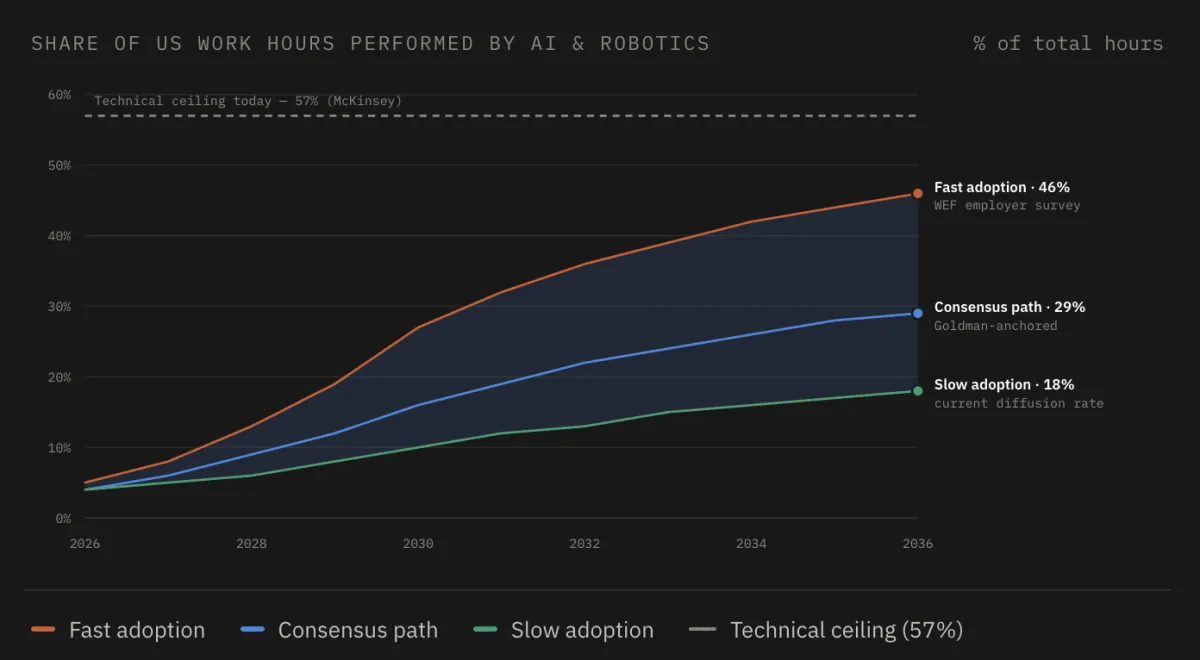
Forecast synthesis · August 2026
The Next 10 Years
Nine major forecasts, put on one axis. The published numbers look wildly different — 25%, 30%, 40%, 57% — mostly because they measure four different things. Once you separate them, the actual center of gravity is narrow.
Scope: United States
Unit: share of total work hours
Horizon: 2026–2036
Today · measured
~4%
Share of US work hours actually performed by AI or robots. 18% of firms use AI at all; most limit it to three tasks.
2030 · central path
~16%
Roughly 1 hour in 6. Published scenarios for 2030 span 10% to 27%.
2036 · central path
~29%
About 3 hours in 10 — close to Goldman’s 25% ceiling, well under McKinsey’s 57% technical limit.
What the numbers actually support
The near term is slower than the noise. Census data through early 2026: only 2% of firms have cut headcount because of AI, and 66% use it to augment rather than replace. The gap between capability and deployment is the whole story of the next five years.
Ten years is where it gets real. Goldman’s base case is a 6–7% worker displacement wave during transition and +0.6pp on unemployment. Metaculus forecasters put total US employment at −2.9% by 2035 against a +3.1% government baseline. Disruptive, not apocalyptic.
Desk work absorbs the hit. The steepest projected declines by 2035 are lawyers and law clerks (−14.6%), financial specialists (−14.2%), and software developers (−13.9%). Nurses (+12.4%) and physicians (+6.1%) grow.
Trades and local service are the shelter. Only 13% of hours are robot-automatable, and that slice is concentrated in warehousing and manufacturing, not on-site service. Anything requiring a truck, a permit, and a physical presence stays human for this whole window.
The back office is the live target. Where AI already bites in local business: phones, scheduling, intake, quoting, follow-up, and bookkeeping. Goldman measured call-center employment running nearly 40% below trend — the first sector with a visible dent.
Adoption is the bottleneck, not capability. 18% of US firms use AI at all; 50–70% of very large firms do. That gap is the entire small-business opportunity — and the reason forecasts that assume instant diffusion run hot.
Reference link: https://claude.ai/code/artifact/126d1bf8-4499-4d78-8d7a-6ce2cc3cf543